
What is the most important measurement when buying a kitchen faucet? The sink hole size is the most critical measurement to ensure your new faucet fits your existing sink.
Choosing a new kitchen faucet can feel overwhelming. There are so many styles, finishes, and features! But before you get lost in the shiny chrome or brushed nickel options, there’s a crucial step you need to take: measuring. Getting the right measurements ensures your new faucet will not only look great but also function perfectly with your current setup. This guide will walk you through everything you need to know to measure for your kitchen faucet, making the selection and installation process a breeze.
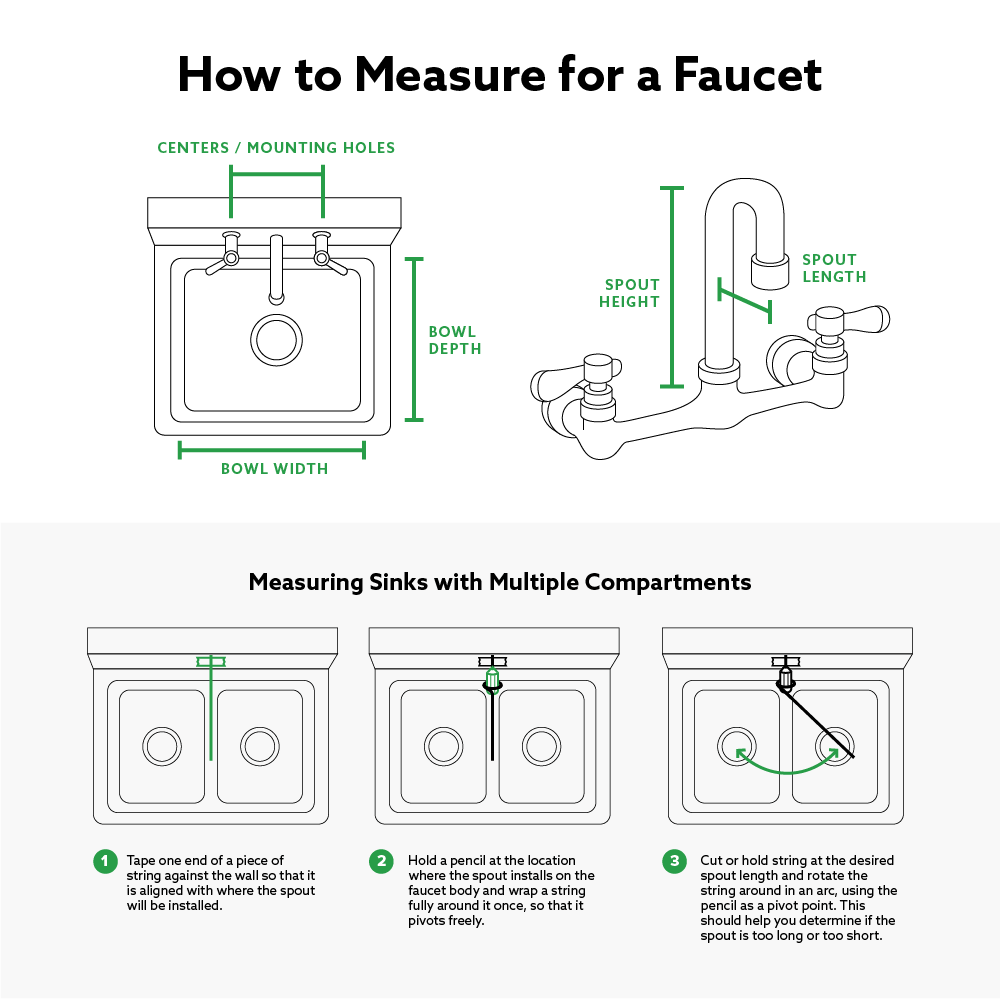
Image Source: lirp.cdn-website.com
Deciphering Your Sink’s Needs: The Essential Measurements
Your existing sink is the foundation for your new faucet. Therefore, accurately measuring its features is paramount.
Hole Spacing: The Crucial Fit
The hole spacing refers to the distance between the mounting holes on your sink or countertop. This is arguably the most important measurement because it dictates how many holes your faucet will need.
- Single-Hole Faucets: These require only one hole in your sink or countertop. Many modern faucets, including pull-down and pull-out models, are designed for single-hole installation.
- Widespread Faucets: These typically have three separate components: the spout and two handles. They require three holes with a specific spacing. The standard hole spacing for widespread faucets is 8 inches from the center of the hot handle hole to the center of the cold handle hole. However, some can accommodate wider configurations.
- Centerset Faucets: These are often a single unit where the spout and handles are mounted on a single base plate. They usually cover two or three holes. The standard hole spacing for centerset faucets is 4 inches.
- Bridge Faucets: These have a distinct look with a pipe connecting the spout to the handles. They generally require three holes, with the spacing varying more than centerset or widespread.
How to Measure Hole Spacing:
- Locate the Holes: Identify the holes in your sink or countertop where your current faucet is mounted.
- Measure from Center to Center: Use a tape measure to find the distance from the center of one hole to the center of another.
- For single-hole, you just need to know there is one hole.
- For widespread, measure from the center of the left handle hole to the center of the right handle hole.
- For centerset, measure from the center of one handle hole to the center of the other handle hole.
- Check for Existing Components: Note if your current faucet has a base plate or deck plate that covers extra holes. If it does, you’ll need to decide if you want to keep using it or if you have enough space to mount a faucet that uses fewer holes.
Sink Hole Size: The Diameter Matters
The sink hole size is the diameter of the opening in your sink or countertop. Faucets are designed to fit through these holes.
How to Measure Sink Hole Size:
- Measure the Diameter: Use a tape measure to measure across the widest part of the hole.
- Standard Sizes: Most kitchen sink holes are standard sizes:
- 1 ½ inches is the most common diameter.
- Some sinks might have slightly larger or smaller holes, especially older or custom-made ones.
- Consider Plates: If your new faucet comes with a deck plate, it will cover a larger area and can often bridge gaps between holes if your existing hole spacing is a bit off from the new faucet’s requirements.
Deck Thickness: How Thick is Your Countertop?
The deck thickness refers to the thickness of the material your faucet will be mounted on (your sink rim or countertop). This is important because the faucet’s mounting hardware and shank length need to be sufficient to pass through and secure the faucet properly.
How to Measure Deck Thickness:
- Measure the Material: If your faucet is already installed, carefully measure the thickness of the sink rim or countertop around the faucet holes.
- Check Manufacturer Specs: If you’re unsure, check the specifications of your sink or countertop material. Standard countertop thicknesses are often around 1 ½ inches.
Gauging Your Faucet’s Reach and Height
Once you’ve assessed your sink’s needs, it’s time to think about the faucet’s physical characteristics and how they’ll interact with your sink and surrounding space.
Faucet Spout Reach: How Far Does it Extend?
The faucet spout reach is the horizontal distance from the center of the faucet base to the aerator (where the water comes out). This measurement determines how far the water will stream into your sink.
How to Measure Faucet Spout Reach:
- Measure from the Center: Place your tape measure at the center point of the faucet base (where it mounts to the sink).
- Extend to the Aerator: Run the tape measure horizontally to the very end of the spout, where the water exits.
- Consider Your Sink:
- A longer faucet spout reach is beneficial for larger sinks, allowing you to easily fill pots and wash large items without them hitting the back of the sink.
- A shorter reach might be suitable for smaller sinks or if you have limited counter space around the sink.
Faucet Spout Height: How High Does it Arc?
The faucet spout height is the vertical distance from the countertop or sink deck to the highest point of the faucet spout. This measurement is crucial for clearing taller items.
How to Measure Faucet Spout Height:
- Measure from the Deck: Place your tape measure on the surface where the faucet mounts (sink rim or countertop).
- Extend to the Spout’s Peak: Measure vertically to the highest point of the faucet spout.
- Consider Your Needs:
- High-arc faucets offer more clearance, making it easier to wash large pots, pans, and even fill up buckets directly at the sink.
- Low-arc or standard-arc faucets are more compact and might be preferred for smaller sinks or if you have cabinets directly above the sink that could interfere with a very tall faucet.
- Important Note: Measure the clearance between your sink and any overhead cabinets or shelves. You don’t want a beautiful, high-arc faucet that can’t fully extend or operate because it hits the cabinet!
Considering Installation and Operation
Beyond the basic fit, several other factors influence your faucet choice and how easily it can be installed and used.
Installation Space: Room to Work
Installation space refers to the amount of room you have behind and around your sink for installing and servicing the faucet. This includes the space for connecting water supply lines and maneuvering tools.
How to Assess Installation Space:
- Check Behind the Sink: Look at the space between the back of your sink and the wall or backsplash. Is there enough room to comfortably reach in and connect the water lines?
- Consider Clearance: Ensure there’s enough space to turn the faucet’s mounting nuts and to manipulate the mounting hardware.
- Wall-Mounted Faucets: If you’re considering a wall-mounted faucet, you’ll need to ensure proper plumbing rough-ins are in place and that there’s adequate clearance from the wall for the faucet itself.
Handle Clearance: Easy Operation
Handle clearance is the space needed around the faucet handles for comfortable and easy operation. This is particularly important if you have limited space in front of the sink.
How to Check Handle Clearance:
- Identify Handle Type: Are your handles on the sides, front, or top of the faucet?
- Measure Swing Arc: If handles swing side-to-side, ensure there’s enough room for them to move freely without hitting a backsplash or wall.
- Consider Spout Reach: A faucet with a longer faucet spout reach might position the handles closer to the edge of the sink, which can affect handle clearance if your sink is very shallow or has a thick rim.
Spray Hose Length: Reach and Retraction
If your faucet has a pull-down or pull-out sprayer, the spray hose length is a key consideration. This determines how far the sprayer can extend from the faucet body.
How to Assess Spray Hose Length:
- Check Faucet Specifications: Manufacturers usually provide the extended spray hose length in their product details.
- Consider Your Sink’s Size: A longer hose is beneficial for larger sinks, allowing you to reach all corners for cleaning.
- Counterweight: Most pull-down and pull-out faucets have a counterweight to help retract the hose. Ensure there’s enough space for the hose to retract smoothly without kinks.
Water Supply Lines: The Connection Points
The water supply lines are the flexible hoses that connect your faucet to the hot and cold water shut-off valves.
How to Measure/Check for Water Supply Lines:
- Locate Shut-Off Valves: Find the hot and cold water shut-off valves under your sink.
- Measure Distance: Measure the distance from the faucet’s connection points (where the supply lines attach to the faucet) to the shut-off valves.
- Standard Lengths: Most faucets come with integrated supply lines of a standard length (often 18-24 inches). If your valves are unusually far from the faucet connections, you may need to purchase longer water supply lines or extension hoses.
- Connection Type: Note the type of connection your faucet and shut-off valves use (usually 3/8-inch compression fittings). Ensure compatibility.
Essential Accessories and Additional Considerations
While the faucet itself is the main event, don’t forget the supporting players.
Mounting Hardware: Securing Your Faucet
The mounting hardware typically includes a mounting nut, washers, and sometimes a stabilizing bracket. These components secure the faucet to the sink or countertop.
What to Check for Mounting Hardware:
- Compatibility: Ensure the mounting hardware provided with your new faucet is compatible with your sink or countertop thickness. If your deck is thicker than standard, you might need extended mounting hardware, which is often available from the faucet manufacturer or specialty plumbing supply stores.
- Ease of Installation: Some modern faucets feature quick-connect systems or tool-free mounting hardware that can simplify installation significantly.
Creating a Measurement Checklist
To make the process even easier, create a checklist of the measurements you need to take.
| Measurement | What to Measure | Why It’s Important |
|---|---|---|
| Sink Hole Size | Diameter of the hole(s) in your sink/countertop. | Ensures the faucet base and shank can pass through. |
| Hole Spacing | Distance between the center of each hole on the sink/counter. | Determines compatibility with single-hole, centerset (4-inch), or widespread (8-inch typical) faucet configurations. |
| Deck Thickness | Thickness of the sink rim or countertop material. | Ensures the faucet’s mounting hardware can securely fasten the faucet. |
| Faucet Spout Reach | Horizontal distance from faucet base to spout end. | Affects how far water streams into the sink, important for large sinks. |
| Faucet Spout Height | Vertical distance from deck to highest point of the spout. | Dictates clearance for washing large items; ensure it clears overhead cabinets. |
| Installation Space | Room behind and around the sink for connections and tools. | Crucial for ease of installation and future maintenance, especially for connecting water supply lines. |
| Handle Clearance | Space around handles for comfortable operation. | Prevents handles from hitting walls or backsplashes during use. |
| Spray Hose Length | Extended length of the pull-down or pull-out sprayer hose. | Allows the sprayer to reach all corners of the sink for cleaning. |
| Water Supply Lines | Distance from faucet connections to shut-off valves. | Determines if existing or purchased water supply lines will be long enough. |
| Existing Faucet Type | Single-handle, dual-handle, pull-down, pull-out, etc. | Helps you visualize the footprint and operational needs of a new faucet. |
Frequently Asked Questions About Faucet Measurements
Can I replace a 3-hole faucet with a 1-hole faucet?
Yes, often you can! If you have a 3-hole sink (like a centerset or widespread) and want to install a single-hole faucet, you can use a faucet that comes with an escutcheon plate or deck plate. This decorative plate covers the extra holes, providing a clean look.
What if my sink holes don’t match standard spacing?
If your hole spacing is unusual, you have a few options:
* Look for faucets specifically designed for your sink’s configuration.
* Use a faucet with a wide deck plate that can cover the existing holes.
* Consider countertop modification or installation of a new sink if neither of the above works.
Do I need to measure my existing faucet’s spout reach and height?
While you can measure your current faucet, it’s more important to measure your sink and the space above it. Your new faucet’s faucet spout reach and faucet spout height should be chosen based on your sink size and any overhead obstructions, rather than just matching your old faucet.
How do I measure for a faucet if I don’t have my sink yet?
If you’re buying a new sink and faucet together, the process is simpler. Check the sink’s product specifications for the number and type of pre-drilled holes. Then, select a faucet that matches those requirements. If the sink comes with a faucet-specific base or no holes, you’ll have more flexibility.
What are common problems encountered during faucet measurement?
Common issues include:
* Not measuring from the center of the holes for hole spacing.
* Forgetting to check installation space behind the sink, which is critical for connecting water supply lines.
* Not considering overhead cabinets when measuring faucet spout height.
* Assuming all sinks have standard hole sizes without measuring the sink hole size.
* Purchasing a faucet with insufficient faucet spout reach for a large sink.
By taking these measurements carefully, you’ll be well-equipped to choose a kitchen faucet that fits perfectly, operates smoothly, and enhances the beauty and functionality of your kitchen. Happy faucet hunting!