
The Kitchen Debate, a famous exchange between Vice President Nixon and Premier Khrushchev, was important because it served as a highly visible public forum for the stark ideological conflict between the United States and the Soviet Union during the Cold War. It vividly demonstrated the contrasting principles of capitalism versus communism through the lens of consumerism and living standards.
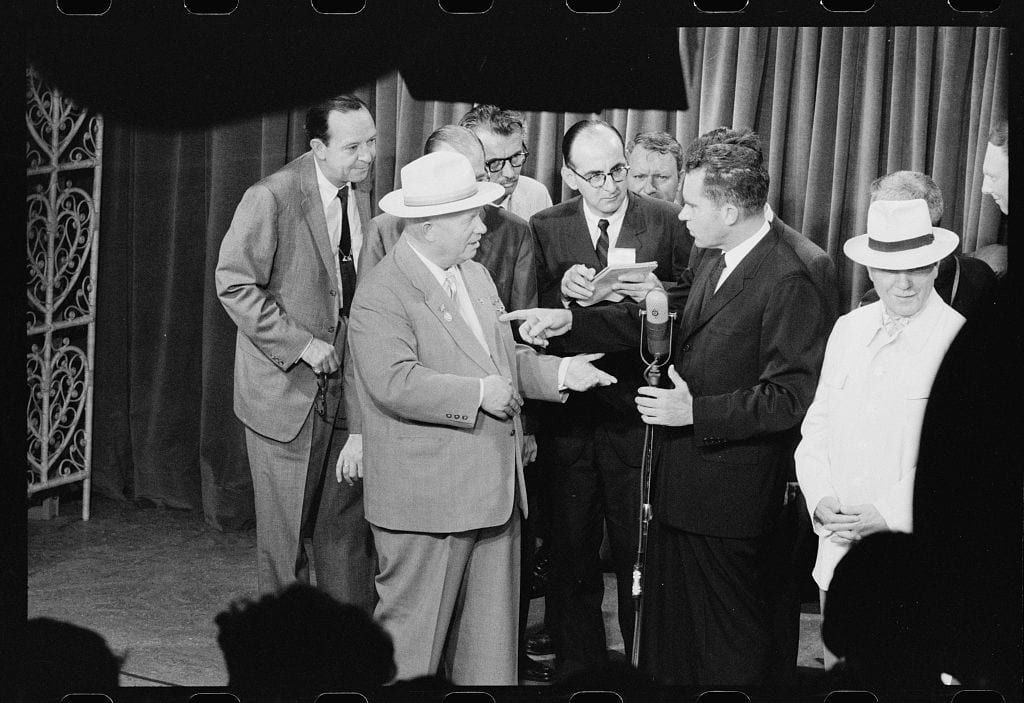
Image Source: teachingamericanhistory.org
Fathoming the Significance of the Nixon-Khrushchev Debate
The Kitchen Debate, a moment etched in the annals of the Cold War, was far more than just a verbal sparring match between two powerful leaders. It was a carefully orchestrated, yet surprisingly candid, clash of ideologies played out on the world stage, with the American exhibition in Moscow serving as its unconventional arena. This exchange between Vice President Nixon and Premier Khrushchev was critically important for several key reasons, offering unparalleled insight into the core tenets of capitalism and communism, the burgeoning role of consumerism as a cultural battleground, and the profound impact of differing living standards on global perceptions.
The American Exhibition: A Showcase of Dreams
The context for this pivotal encounter was the American National Exhibition in Moscow, an event designed to showcase American life, technology, and culture to the Soviet people. It was a deliberate effort by the United States to present a compelling alternative to the Soviet system, highlighting the perceived benefits of freedom and free markets. The exhibition was a sprawling affair, featuring everything from advanced electronics and automobiles to fashion and, crucially, a model American home. This model home, complete with modern appliances, was to become the focal point of the debate.
Premier Khrushchev’s Arrival: A Calculated Move
Premier Khrushchev, upon his visit to the exhibition, found himself drawn to the meticulously staged American kitchen. It was a stark representation of a lifestyle that was, for most Soviet citizens, a distant aspiration. The appliances – the dishwasher, the gleaming refrigerator, the automated oven – symbolized a level of material comfort and convenience that stood in sharp contrast to the realities faced by many in the Soviet Union. Khrushchev’s decision to engage directly with Vice President Nixon in this setting was a strategic one. He aimed to critique the perceived superficiality of American consumerism and to assert the superiority of the Soviet system, which he argued prioritized the collective good and ideological purity over material possessions.
The Clash of Two Worlds: Capitalism vs. Communism
The core of the Kitchen Debate revolved around the fundamental differences between capitalism and communism. Nixon, representing the United States, argued that the abundance and variety of consumer goods on display were direct results of the capitalist system, which fostered innovation, competition, and individual prosperity. He pointed to the ease and comfort provided by these appliances as evidence of the success of American free enterprise.
Khrushchev, on the other hand, countered by emphasizing the perceived shortcomings of capitalism, particularly its focus on material wealth and its alleged tendency to create inequality. He argued that the Soviet Union was making significant advancements in areas like space exploration and heavy industry, achievements that he believed were more important for the progress of humanity than the proliferation of washing machines. He sought to portray American consumerism as a distraction, a way to pacify the populace and mask underlying social problems.
Key Points of Contention:
- Consumer Goods: Nixon highlighted the availability and affordability of consumer goods as a measure of success, while Khrushchev questioned their ultimate value and the societal cost of their production.
- Technological Advancement: Both leaders cited technological achievements, but from different perspectives. Nixon emphasized consumer-oriented innovations, while Khrushchev focused on state-driven, often military-related, advancements.
- Standard of Living: The debate directly addressed the differing standards of living. Nixon presented the American home as a model of comfort and efficiency, a tangible manifestation of a high standard of living. Khrushchev sought to reframe the definition of living standards, emphasizing social progress and ideological fulfillment.
The Role of Consumerism: A New Battlefield
The Kitchen Debate underscored the growing importance of consumerism as a battleground in the ideological conflict. In the post-war era, the United States had experienced an unprecedented boom in consumer goods, transforming lifestyles and creating a society of abundance. This affluence became a powerful symbol of American success and a key element of its “soft power.” The Soviet Union, while achieving significant industrial growth, lagged behind in the production and availability of consumer goods for its citizens.
Nixon effectively leveraged the tangible evidence of American consumer culture, using it to demonstrate the material benefits of capitalism. The ease with which an American could operate the appliances, the sheer variety of choices available – these were potent symbols of freedom and prosperity. Khrushchev’s challenge was to devalue this, to argue that this material comfort came at too high a price, or was simply a superficial gloss.
Consumerism as Propaganda:
- American Perspective: Consumer goods were presented as proof of economic freedom and the success of the free market.
- Soviet Perspective: Consumer goods were criticized as a distraction from more important societal goals and a source of inequality.
Living Standards: A Stark Contrast
Perhaps the most enduring takeaway from the Kitchen Debate was the stark contrast it illuminated in the living standards of ordinary citizens in the two superpowers. While both nations could boast of significant achievements, the visible differences in the everyday lives of their people were profound. The model American kitchen, with its labor-saving devices, represented a level of domestic convenience that was virtually unknown to the average Soviet household.
Nixon’s ability to demonstrate the practical benefits of these appliances, even down to their ease of use for a typical American housewife, was a masterful stroke. He was not just talking about abstract economic theories; he was showing the tangible results of those theories in people’s lives. Khrushchev’s counterarguments, while ideologically sound from the Soviet perspective, struggled to overcome the visual impact of the American lifestyle. His attempts to steer the conversation towards ideological superiority and collective achievements couldn’t entirely erase the image of the well-equipped, convenient American home.
Comparing Living Standards:
| Feature | American Exhibition Kitchen (Nixon’s Argument) | Soviet Reality (Khrushchev’s Context) |
|---|---|---|
| Appliances | Abundant, varied, designed for convenience and labor-saving. | Scarce, often basic, focused on essential functionality. |
| Home Comfort | High degree of comfort, ease of use, emphasis on personal time. | Functional, but less emphasis on domestic convenience and leisure. |
| Availability | Widely available to the middle class, often a symbol of upward mobility. | Limited availability, often requiring significant effort to obtain. |
| Choice | Wide range of brands and models, reflecting consumer choice and competition. | Limited choice, often state-controlled production. |
| Time Savings | Appliances freed up time for leisure, family, or work outside the home. | Domestic tasks often more time-consuming, limiting other pursuits. |
The Impact on Global Perception
The Kitchen Debate was broadcast and reported globally, reaching millions of people. For many, it was their first direct exposure to the starkly different realities of life under capitalism and communism. The visual contrast, coupled with the verbal exchanges, offered a powerful, albeit simplified, narrative of the Cold War.
- For the West: The debate reinforced the idea that capitalism led to greater material prosperity and individual freedom. It was seen as a victory for American values and a validation of their economic system.
- For the East: While many in the Soviet Union might have been impressed by the material abundance, the debate also provided fodder for official propaganda that sought to portray Western consumerism as decadent and soul-less. However, for those in developing nations, the allure of American living standards was undeniable.
The Legacy of the Exchange
The Nixon-Khrushchev debate, though brief, left an indelible mark on the Cold War narrative. It demonstrated the effectiveness of using cultural and material displays as tools of foreign policy. It highlighted how deeply intertwined economic systems were with political ideologies and how the promise of a better life, measured in tangible goods and conveniences, could be a potent persuasive force.
The debate also offered a rare, unscripted glimpse into the personalities and perspectives of the two leaders. Nixon, the confident salesman of the American dream, and Khrushchev, the blustering but often shrewd counter-argument, engaged in a verbal joust that captivated the world. It revealed the confidence of the United States in its system and the Soviet Union’s defensive posture regarding its economic model.
Key Takeaways from the Legacy:
- Cultural Diplomacy: The power of cultural exchange as a diplomatic tool.
- Soft Power: The effectiveness of showcasing lifestyle and consumer goods as a form of influence.
- Ideological Warfare: The use of economic and social conditions as weapons in the Cold War.
- Public Diplomacy: The impact of direct, televised interactions between leaders on global opinion.
Conclusion: A Defining Moment
The Kitchen Debate was more than just a spat over kitchen appliances. It was a microcosm of the larger Cold War struggle, a vivid illustration of the fundamental differences in economic and political systems. The debate between Vice President Nixon and Premier Khrushchev, set against the backdrop of an American exhibition showcasing the fruits of consumerism, served to highlight the vastly different living standards achieved under capitalism and communism. It cemented the idea that the competition for global influence would not only be fought on battlefields but also in the markets and homes of ordinary people, a testament to the enduring power of material well-being as a persuasive argument in the theater of international relations. The American exhibition provided a tangible vision of a prosperous future, a vision that the Soviet Union, despite its own achievements, struggled to fully counter in the eyes of a watching world.
Frequently Asked Questions (FAQ)
Q1: What exactly was the “Kitchen Debate”?
The Kitchen Debate was a public, informal discussion between U.S. Vice President Richard Nixon and Soviet Premier Nikita Khrushchev at the American National Exhibition in Moscow on July 24, 1959. They debated the merits of capitalism versus communism while standing in a model American kitchen.
Q2: Why was the American exhibition in Moscow significant?
The American exhibition was significant because it aimed to showcase American culture, technology, and living standards to the Soviet public, offering a stark contrast to the Soviet system and serving as a platform for cultural diplomacy during the Cold War.
Q3: What was Premier Khrushchev’s main argument during the debate?
Premier Khrushchev argued that the Soviet Union was superior to the United States, focusing on advancements in science and industry, and he criticized American consumerism as superficial and a distraction from more important societal progress.
Q4: What was Vice President Nixon’s main argument?
Vice President Nixon countered by highlighting the abundance of consumer goods and the high standard of living in the United States, attributing these benefits to the capitalist system and free enterprise.
Q5: How did consumerism play a role in the Kitchen Debate?
Consumerism was central to the debate, with the American kitchen appliances symbolizing the material comforts and conveniences that capitalism offered, which Nixon presented as evidence of American success, while Khrushchev downplayed their significance.
Q6: What was the impact of the Kitchen Debate on global perceptions?
The debate significantly impacted global perceptions by visually and verbally contrasting the perceived benefits of capitalism (material prosperity) and communism (ideological progress), influencing how people around the world viewed the two superpowers.