
Image Source: www.regattaexports.com
How Tall Are Kitchen Countertops? Standard Heights and What You Need to Know
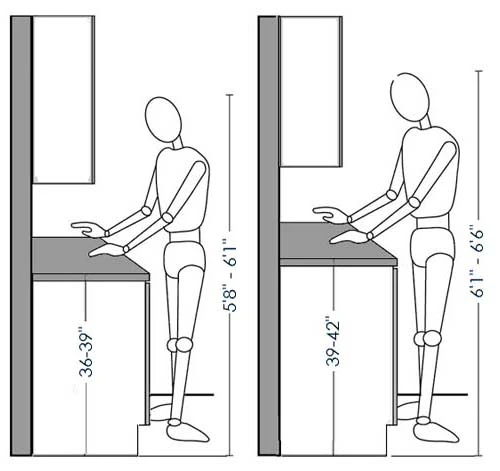
The standard kitchen countertop height in the United States is 36 inches (91.44 cm) from the floor to the top of the counter surface. This measurement is the most common and forms the basis for much of the kitchen’s design.
Why 36 Inches? The Foundation of Kitchen Layouts
That 36-inch mark isn’t an arbitrary number; it’s a cornerstone of ergonomic kitchen design. This height was established to cater to the average adult, providing a comfortable workspace height for a wide range of tasks, from chopping vegetables to mixing ingredients. When planning your kitchen, this standard is your starting point. It dictates the height of your standard kitchen cabinet height, as the countertop typically sits directly on top of the base cabinets.
Delving Deeper: Countertop Dimensions and Variations
While 36 inches is the standard, it’s crucial to look beyond just height. Understanding the full picture of countertop dimensions involves considering depth and thickness as well.
Standard Counter Depth: More Than Just a Number
The typical standard counter depth is 24 inches. This measurement refers to the depth of the base cabinets before any countertop overhang. This depth is designed to provide ample working space and house standard base cabinets efficiently.
- Working Depth: With the countertop installed, the actual usable depth is usually around 25 to 25.5 inches, accounting for the countertop material’s thickness and the standard countertop overhang.
- Why Depth Matters: A sufficient depth is vital for preparing food comfortably. It allows you to keep prep bowls, cutting boards, and utensils on the counter without feeling cramped.
Countertop Thickness: A Matter of Style and Durability
Countertop thickness can vary significantly based on the material.
- Granite and Quartz: These materials are commonly 2cm (about 3/4 inch) or 3cm (about 1 1/4 inches) thick. Thicker slabs often convey a more substantial and luxurious feel.
- Laminate: Laminate countertops are typically 1/4 inch to 3/4 inch thick, often with a particleboard or plywood core.
- Solid Surface: These can range from 1/2 inch to 1.5 inches thick.
- Butcher Block: Often 1.5 inches to 2 inches thick.
The thickness of the countertop material will slightly alter the overall height from the floor, so it’s a factor to consider when factoring in that 36-inch standard.
Countertop Overhang: Balancing Function and Form
The countertop overhang is the portion of the countertop that extends beyond the front of the base cabinets.
- Standard Front Overhang: Typically 1.5 inches. This provides comfortable knee clearance when seated at the counter and offers a pleasing aesthetic.
- Side Overhang: Often 1 to 1.5 inches, depending on the cabinet design and desired look.
- Overhang for Seating: When a countertop is used for seating (like on a kitchen island), the overhang needs to be significantly larger, often 10-15 inches, to accommodate seating comfortably.
The Versatile Kitchen Island: Height Considerations
A kitchen island is a dynamic element, and its kitchen island height often mirrors the standard countertop height of 36 inches. However, islands offer more flexibility.
- Standard Island Height: Most commonly 36 inches, aligning with the main countertops for a cohesive feel and consistent workspace height.
- Multi-Level Islands: Some islands are designed with different heights. A lower section might be at the standard 36 inches for prep work, while a raised bar section could be 42 inches high, perfect for casual dining.
- Ample Overhang is Key: For islands meant for seating, a substantial overhang of 10-15 inches is crucial. This allows chairs or stools to be tucked underneath without bumping into the cabinets. The supporting structure for this overhang (like knee braces or a thicker countertop slab) also needs to be factored into the overall design.
Adapting to Needs: Beyond the Standard
While 36 inches is the norm, modern kitchens are increasingly designed to accommodate a wider range of users and needs.
Accessible Design: ADA Compliant Counters
The Americans with Disabilities Act (ADA) provides guidelines for accessible design, and these extend to kitchens. ADA compliant counters are designed for individuals who use wheelchairs or have other mobility impairments.
- Knee Clearance: A primary feature is the requirement for knee clearance. This means there must be an open space beneath the countertop.
- Accessible Height Range: ADA guidelines specify a maximum countertop height of 34 inches from the floor, with a minimum clear knee space of 27 inches from the finished floor to the underside of the countertop. The clear knee space should extend at least 19 inches back from the front edge of the counter.
- Clear Floor Space: There must also be adequate clear floor space for a wheelchair to maneuver, typically 30 inches by 48 inches.
- Placement: At least one-third of the total counter space in a kitchen must be accessible.
When designing for accessibility, you’ll often see lower workstations or sections of the counter designed to meet these specifications.
Bar Height Counters: For Lounging and Entertaining
Beyond the standard prep surface, bar height counters offer a different functionality.
- Bar Height Standard: Typically around 42 inches (106.68 cm) from the floor. This is the height of most bar stools.
- Functionality: These are common on kitchen islands or as standalone bars for casual dining, serving drinks, or socializing.
- Overhang Requirements: Similar to islands with seating, an adequate overhang of 10-15 inches is necessary for comfortable seating.
Countertop for Shorter Individuals: Customized Solutions
Not everyone fits the “average” mold. For shorter individuals, the standard 36-inch height might feel too high, impacting comfort and ergonomic kitchen design.
- Lowering the Workspace: Custom base cabinets can be ordered to a lower height, such as 30 or 32 inches. This would result in a finished countertop height of 30-32 inches, making prep work more comfortable.
- Modular Systems: Some modular kitchen systems allow for different cabinet heights.
- Impact on Appliances: It’s important to consider how lowering countertops will affect standard appliance sizes, particularly dishwashers and ovens, which are designed for a 36-inch height.
Countertop for Taller Individuals: Raising the Bar
Conversely, taller individuals might find the standard 36 inches too low, leading to back strain.
- Raising the Workspace: You can opt for taller base cabinets, or use thicker countertop materials, or even a combination. For instance, 30-inch base cabinets topped with a 3cm (1.25 inch) thick countertop would result in a finished height of 31.25 inches. To reach a higher workstation, you might consider 33-inch base cabinets.
- Appliance Compatibility: Ensure that any adjustments still allow for standard appliance installation.
Factors Influencing Countertop Height Decisions
When deciding on your kitchen countertop height, several factors come into play:
- Primary Users: Who will be using the kitchen most often? Consider the heights of the main cooks and any children or elderly individuals who will be spending time in the kitchen.
- Intended Use: Is the counter primarily for prep work, dining, or both?
- Appliance Integration: Ensure that your chosen height works with standard appliance dimensions (dishwashers, ranges, etc.).
- Aesthetics: The overall visual balance of the kitchen can be influenced by countertop height, especially in relation to cabinetry and other design elements.
- Budget: Custom cabinet heights or specialized countertop thicknesses can increase costs.
Typical Kitchen Cabinet Height and Its Relation to Countertops
The standard kitchen cabinet height for base cabinets is 34.5 inches. When you add a standard 1.5-inch thick countertop, this brings the total height to the universally recognized 36 inches.
- Base Cabinet Construction: Base cabinets are typically built with a toe kick at the bottom (usually 4-4.5 inches high) and then the cabinet box itself. The 34.5-inch height accounts for the cabinet box and the slight recess for the toe kick.
- Wall Cabinet Height: For completeness, wall cabinets typically come in heights of 30, 36, or 42 inches, and are mounted above the countertop, leaving a backsplash space.
Common Mistakes to Avoid
When planning your kitchen, be mindful of these common pitfalls related to countertop height:
- Ignoring User Height: Designing solely based on the standard without considering the actual users can lead to an uncomfortable or even painful kitchen experience.
- Forgetting Appliance Requirements: Lowering countertops too much can create issues with dishwasher doors or range installations.
- Lack of Planning for Overhangs: Underestimating the required overhang for seating or even just for aesthetic balance can ruin the functionality of an island or breakfast bar.
- Not Considering ADA Compliance Early: If accessibility is a potential need now or in the future, it’s best to incorporate it from the initial design phase.
Frequently Asked Questions (FAQ)
Q1: What is the standard kitchen countertop height in the UK?
A1: In the UK, the standard kitchen countertop height is typically around 90 cm (approximately 35.4 inches). This is very close to the US standard of 36 inches, reflecting similar ergonomic considerations.
Q2: Can I have different countertop heights in my kitchen?
A2: Absolutely! Many modern kitchens feature multiple workstation heights to improve ergonomic kitchen design. For example, a lower section for dough preparation and a higher section for general use or as a breakfast bar.
Q3: What determines the countertop overhang?
A3: The countertop overhang is determined by a combination of aesthetics, functionality, and structural support. The standard front overhang is typically 1.5 inches for clearance and appearance. For seating areas, a much larger overhang of 10-15 inches is needed to accommodate chairs and people comfortably. The type of countertop material and the supporting structure underneath also play a role in how much overhang is feasible.
Q4: How thick should my countertops be?
A4: The thickness of your countertops depends on the material chosen and the desired look. Common thicknesses for granite and quartz are 2cm (3/4 inch) and 3cm (1 1/4 inches). Thicker countertops can provide a more substantial appearance and potentially allow for larger overhangs without requiring additional support. Laminate countertops are generally thinner.
Q5: What is a standard kitchen island height?
A5: The most common kitchen island height matches the standard countertop height of 36 inches. However, islands can also be designed with integrated seating at bar height counters (around 42 inches) or at counter height with a raised bar, offering different functional zones.
Q6: How do I make my kitchen ADA compliant?
A6: To make your kitchen ADA compliant counters, you need to ensure a minimum of 27 inches of clear knee space from the floor to the underside of the counter, with a depth of at least 19 inches, and a maximum countertop height of 34 inches. You also need adequate clear floor space for wheelchair maneuverability and ensure at least one-third of your counter space meets these requirements.
Q7: What is the standard counter depth?
A7: The standard counter depth of the base cabinet is 24 inches. This provides a usable workspace depth of around 25 to 25.5 inches once the countertop material and overhang are factored in.
Q8: Can I install countertops higher than 36 inches?
A8: Yes, you can install countertops higher than 36 inches, especially if the primary users are taller. You can achieve this by using taller base cabinets or incorporating thicker countertop materials. Always check appliance compatibility, as most standard appliances are designed for a 36-inch height.
Q9: What is the purpose of the toe kick on base cabinets?
A9: The toe kick is the recessed area at the bottom of base cabinets, typically 4-4.5 inches high. Its purpose is to provide ergonomic kitchen design by allowing you to stand closer to the countertop without hitting your feet against the cabinet face, making prep work more comfortable.
Q10: What are some options for customizing countertop height?
A10: Customizing countertop height can involve ordering base cabinets in non-standard heights, using thicker countertop materials, or incorporating built-up edges. For lower heights, specialized cabinets or even custom-built bases can be used. Always consider appliance dimensions and accessibility needs.