
The standard kitchen counter depth is typically 24 inches. This depth is a widely accepted norm that balances workspace, storage, and appliance integration.
When designing or renovating a kitchen, one of the most fundamental decisions you’ll make is the depth of your countertops. This seemingly simple measurement significantly impacts your kitchen’s functionality, workflow, and even the types of appliances you can comfortably use. So, how deep is a kitchen counter? The answer, for the most part, is a standard 24 inches. However, like many things in design, there’s room for variation and specific considerations. This article will delve into the reasons behind the standard depth, explore common variations, and discuss how different depths affect your kitchen’s usability, from the efficiency of your work triangle to the placement of your appliances.
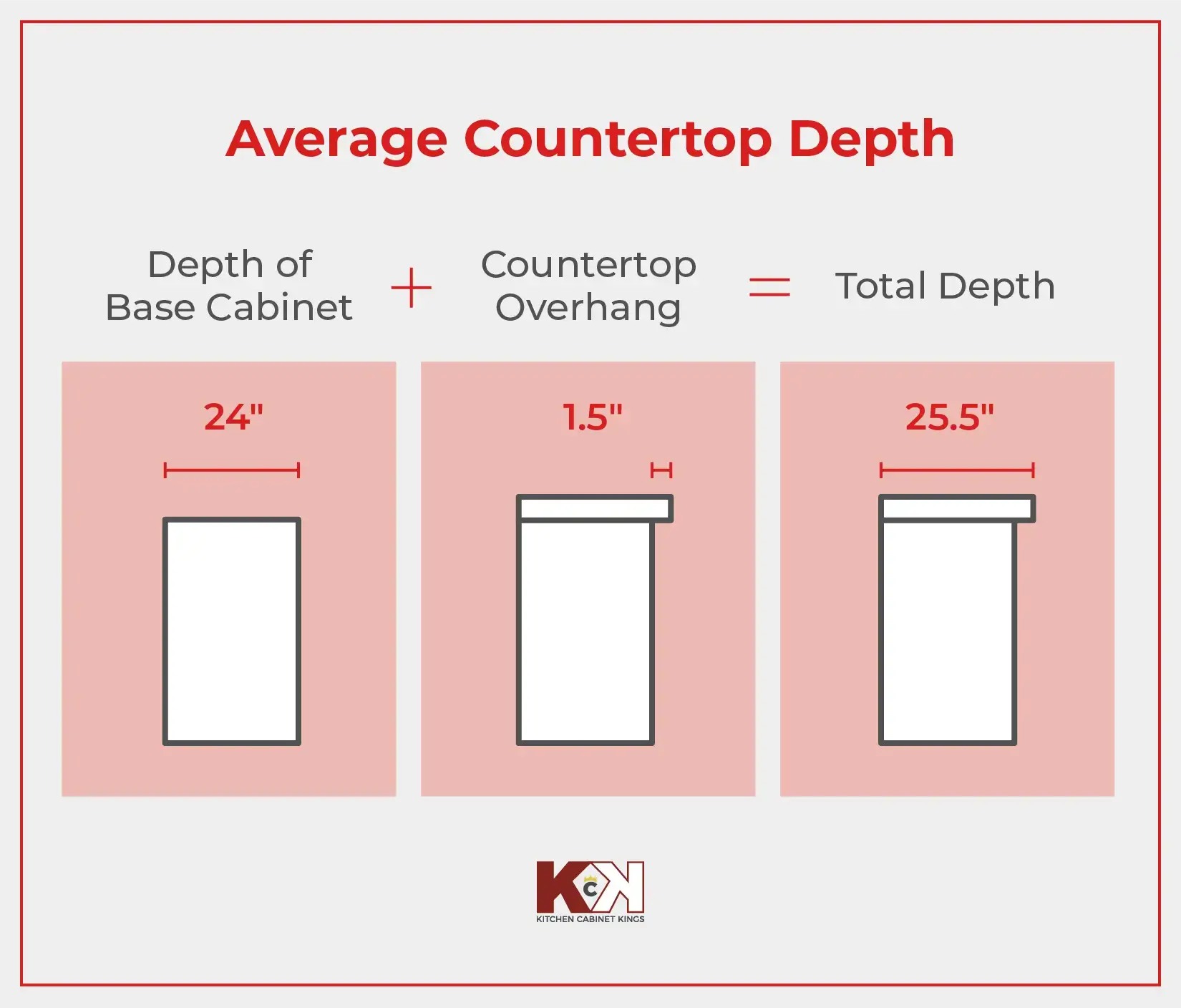
Image Source: cdn.kitchencabinetkings.com
The Rationale Behind the 24-Inch Standard
The 24-inch kitchen counter depth isn’t an arbitrary number. It’s a result of careful consideration of several factors that contribute to a well-functioning kitchen:
-
Appliance Fit: Many standard kitchen appliances, such as base cabinets and dishwashers, are designed to fit within a 24-inch depth. This allows for a seamless integration between your cabinetry and appliances, creating a clean and cohesive look. A 24-inch depth also provides adequate space for appliance doors to open fully without obstruction.
-
Workspace and Ergonomics: This depth offers a comfortable amount of space for food preparation, cooking, and cleaning. It allows you to chop vegetables, mix ingredients, and plate meals without feeling cramped. The ergonomic advantage means you can work at the counter without excessive leaning or reaching, reducing strain.
-
Cabinetry Integration: Standard kitchen cabinets are typically 24 inches deep. This allows the countertop to overhang slightly, providing protection for the cabinet fronts and a comfortable gripping edge. The typical kitchen cabinet dimensions are designed around this countertop depth.
-
Traffic Flow: A 24-inch depth, when combined with standard aisle widths, helps maintain good traffic flow within the kitchen. It prevents the kitchen from feeling claustrophobic and allows multiple people to move around comfortably. This is especially important for optimizing work triangle efficiency and ensuring a smooth small kitchen workflow.
Exploring Countertop Depth Variations
While 24 inches is the standard, you might encounter or choose different depths for specific reasons:
Increased Workspace: The Deeper Countertop
-
Benefits: Opting for a deeper countertop, often 30 inches or more, can significantly expand your usable workspace. This is particularly beneficial for:
- Serious Cooks and Bakers: Those who frequently prepare elaborate meals or bake will appreciate the extra room for multiple prep bowls, cutting boards, and appliances like stand mixers.
- Appliance Integration: Deeper counters can accommodate deeper appliances, such as counter depth refrigerator models that offer a more flush appearance, or specialized built-in appliances.
- Design Aesthetics: Deeper counters can create a more substantial and luxurious feel, especially in larger kitchens.
-
Considerations:
- Reachability: Very deep countertops can make it difficult to reach items stored at the back of the counter or within the cabinets below. This is where under cabinet lighting clearance becomes important, ensuring adequate light reaches the entire workspace.
- Cost: Custom-sized countertops, especially those that are deeper than standard, can be more expensive due to material usage and custom fabrication.
- Kitchen Size: In smaller kitchens, excessively deep counters can encroach on walkway space, negatively impacting your small kitchen workflow and overall usability.
Maximizing Cabinet Space: The Shallower Countertop
-
Benefits: In very compact kitchens or specific design scenarios, a shallower countertop (e.g., 20-22 inches) might be considered. This can be useful for:
- Creating More Aisle Space: In tight layouts, a slightly shallower counter can gain a few inches of precious walkway space, improving accessibility and the work triangle efficiency.
- Specific Cabinetry: Some European-style or custom cabinetry might be designed for shallower countertops.
-
Considerations:
- Limited Workspace: The primary drawback is a significantly reduced workspace, which can make food preparation challenging.
- Appliance Fit Issues: Standard appliances might not fit flush or may overhang the countertop, creating an awkward aesthetic and potential safety hazard. You might need to choose specific, shallower appliance models.
- Aesthetic Balance: A very shallow countertop might look out of proportion with standard cabinetry.
The Kitchen Island: A Different Depth Dynamic
Kitchen islands often present an opportunity for different countertop depths, driven by their multipurpose nature.
Standard Kitchen Island Depth
-
Typical Range: While a standard island might mirror the perimeter countertop depth of 24 inches, it’s common to see kitchen island depth ranging from 30 inches to 42 inches or even more.
-
Factors Influencing Island Depth:
- Seating: If the island will incorporate seating, you’ll need to account for comfortable legroom and the overhang of the countertop. A typical seating overhang is 10-15 inches.
- Appliance Integration: Islands often house appliances like cooktops, sinks, or dishwashers. These appliances have their own depth requirements, which will influence the overall island depth. For example, a sink base cabinet might be 30 inches deep, requiring a countertop that accommodates this.
- Storage: Deeper islands allow for more extensive storage solutions, such as pull-out shelves, drawers, or specialized cabinets.
- Workspace: A larger island can serve as a dedicated prep zone, benefiting from extra depth.
-
Considerations for Island Depth:
- Traffic Flow: Ensure that the island’s depth, combined with adequate surrounding clearances (at least 36 inches, preferably 42-48 inches), doesn’t impede movement within the kitchen. This is crucial for maintaining work triangle efficiency.
- Scale and Proportion: The island’s depth should be in proportion to the size of your kitchen. An overly large island can overwhelm a small space.
Table: Common Countertop Depths and Their Implications
| Countertop Depth (Inches) | Primary Uses and Benefits | Considerations and Drawbacks |
|---|---|---|
| 24 | Standard for base cabinets, good workspace, fits most appliances | May feel tight for extensive prep, limited appliance options if deeper units are desired. |
| 30-36 | Increased prep space, accommodates deeper appliances, substantial aesthetic | Can be too deep for small kitchens, reachability issues for items at the back, potentially higher cost. |
| 20-22 | Maximizes aisle space in very small kitchens, specific cabinetry | Significantly reduced workspace, potential appliance fit issues, may look unbalanced with standard cabinets. |
| Island Specific (30-42+) | Ample workspace, seating overhang, appliance integration, storage | Requires careful planning for traffic flow, can overwhelm small spaces, cost considerations for custom sizes. |
Countertop Installation Depth: More Than Just the Slab
When discussing countertop installation depth, it’s important to remember that this measurement often includes a slight overhang.
-
Standard Overhang: Typically, countertops extend 1 to 1.5 inches beyond the front of the base cabinets. This overhang serves several purposes:
- Protection: It shields the cabinet fronts from spills and splashes.
- Ergonomics: It provides a comfortable lip to lean against or grip when working at the counter.
- Aesthetics: It creates a finished and intentional look.
-
Impact on Depth: If your base cabinets are 24 inches deep, and you have a 1.5-inch overhang, the total kitchen counter depth from the wall to the front edge of the counter will be 25.5 inches. This overhang is a key factor in determining the usable working surface.
Fathoming Functional Depth: How Much Counter Space Do I Need?
Deciding how much counter space do I need is a crucial step in kitchen design. The depth of your counters is a significant contributor to this usable space.
-
Assess Your Cooking Habits:
- Light Cook: If you primarily reheat meals or do minimal cooking, standard 24-inch deep counters might suffice.
- Everyday Cook: For regular meal preparation, a mix of standard and slightly deeper sections (perhaps on an island) can be beneficial.
- Enthusiast Cook/Baker: If you frequently host, bake, or experiment with complex recipes, maximizing counter depth and length is key. Consider deeper counters and a spacious island.
-
Consider Appliance Placement:
- Sink: Ensure enough counter space on either side of the sink for drying dishes or placing washed items. A common recommendation is at least 18 inches of landing space on each side.
- Cooktop/Range: You’ll need ample counter space on either side of the cooktop for placing hot pans, ingredients, and utensils. Aim for at least 18-24 inches on each side.
- Microwave/Small Appliances: Designate specific zones for frequently used appliances to keep them off the main prep areas.
-
Think About Workflow:
- Prep Zone: This is typically located between the sink and the cooktop. More depth here is always beneficial.
- Cleaning Zone: Usually adjacent to the sink and dishwasher.
- Serving Zone: An area for plating meals, often near the dining area or island.
The Impact of Depth on Small Kitchen Workflow
In a small kitchen workflow, every inch counts. The depth of your countertops plays a critical role in making the most of limited space.
-
Balancing Depth and Aisle Width: In a small kitchen, choosing a counter depth that is too deep can severely restrict aisle space. This can make it difficult to move around, open appliance doors, or even have two people working in the kitchen simultaneously. Prioritizing sufficient aisle clearance (minimum 36 inches, ideally 42 inches) is paramount.
-
Strategic Depth: You might consider:
- Standard Perimeter: Stick to the 24-inch standard for your perimeter cabinets to maintain good traffic flow.
- Island or Peninsula: If you have the space for an island or peninsula, you might opt for a slightly deeper countertop on this element to provide a dedicated workspace without compromising the main traffic paths. This can effectively increase your how much counter space do I need calculation without making the kitchen feel smaller.
-
Appliance Choices:
- Counter Depth Refrigerators: As mentioned, these are designed to be shallower, aligning more closely with standard counter depths, and can prevent them from jutting out into the walkway.
- Compact Appliances: Consider smaller-footprint appliances that are specifically designed for tight spaces.
Countertops and Appliances: A Closer Look
The relationship between countertop depth and appliance dimensions is crucial for a well-integrated kitchen.
Counter Depth Refrigerators
A counter depth refrigerator is designed to sit more flush with your cabinetry. While their external width and height are similar to standard refrigerators, their depth is typically around 24 to 28 inches (including the door). This contrasts with traditional refrigerators that can be 30 to 33 inches deep or more.
- Benefit: This creates a more seamless, built-in look and prevents the refrigerator from protruding too far into the kitchen, which is especially advantageous in smaller kitchens or those with narrow walkways.
- Consideration: Counter depth refrigerators often have slightly less internal storage capacity than their standard-depth counterparts due to their shallower design.
Dishwashers and Sinks
Standard dishwashers are designed to fit within a 24-inch deep cabinet opening. Their control panels are typically flush with or slightly proud of the countertop edge. Similarly, standard sink base cabinets are usually 24 inches deep, accommodating most sink sizes and depths. When selecting a sink, consider not just its bowl dimensions but also the overall cabinet space it requires.
Materials and Depth: Does It Matter?
The material of your countertop generally doesn’t dictate the standard depth, but it can influence how deeper or custom depths are achieved and their cost.
- Natural Stone (Granite, Quartzite, Marble): These materials are typically available in slabs that are 2cm or 3cm thick. Fabrication can accommodate various lengths and depths. Deeper slabs might be more expensive or harder to source, and cutting deeper countertops might result in more material waste.
- Engineered Quartz: Similar to natural stone, quartz can be fabricated to custom depths. It’s a durable and non-porous option.
- Solid Surface (Corian, etc.): This material is often fabricated in custom sizes and can be a good option for achieving non-standard depths seamlessly.
- Laminate: This is often the most budget-friendly option and can be ordered in custom depths, though the selection of edge profiles and finishes might be more limited for non-standard sizes.
- Butcher Block: Wood countertops can be readily cut to custom depths, offering a warm aesthetic.
Regardless of the material, the countertop installation depth is a fabrication choice that needs to be specified precisely.
Frequently Asked Questions (FAQ)
Q: Can I make my kitchen countertops deeper than 24 inches?
A: Yes, you can absolutely make your kitchen countertops deeper than 24 inches. This is a common customization that many homeowners opt for to gain more workspace. However, it’s important to consider the impact on traffic flow, reachability, and appliance fit.
Q: What is the standard overhang for a kitchen counter?
A: The standard overhang for a kitchen counter is typically 1 to 1.5 inches. This provides protection for the cabinets and a comfortable edge for working.
Q: How much clearance do I need for under cabinet lighting?
A: The clearance needed for under cabinet lighting depends on the type of lighting used. LED strips are usually very slim and require minimal clearance. However, ensure that the lighting doesn’t create glare on your countertop or obstruct your view of the work surface. A general guideline is to have at least 18 inches of vertical clearance between the bottom of your upper cabinets and the countertop to allow for comfortable working.
Q: How does countertop depth affect work triangle efficiency?
A: Countertop depth affects work triangle efficiency by influencing the amount of usable workspace. Deeper counters can expand the prep area, making the movement between the sink, refrigerator, and stove more efficient. However, if the depth is excessive in a small kitchen, it can narrow aisleways, hindering movement and reducing overall efficiency.
Q: What are typical kitchen island dimensions?
A: Typical kitchen island depth can range from 24 inches for a simple workspace to 30-42 inches or more if it includes seating, appliances, or significant storage. Island length varies greatly based on kitchen size and design.
Q: What are standard kitchen cabinet dimensions?
A: Standard kitchen cabinet dimensions for base cabinets are typically 24 inches deep and 34.5 inches high (before the countertop is added). Upper cabinets are usually 12 inches deep and 30-36 inches high. These dimensions are designed to work harmoniously with standard countertop depths.
Q: How can I maximize counter space in a small kitchen?
A: To maximize counter space in a small kitchen, consider using the standard 24-inch depth for perimeter cabinets to maintain good small kitchen workflow. Utilize a peninsula or a narrower island with a slightly deeper countertop for extra prep space. Incorporate vertical storage, fold-down countertops, or wall-mounted cutting boards. Choose appliances that are appropriately sized, such as a counter depth refrigerator.
In conclusion, while 24 inches is the bedrock of kitchen counter depth, the ideal measurement for your kitchen is a personalized decision. By carefully considering your cooking habits, the size of your kitchen, and the appliances you plan to use, you can determine the perfect depth to create a functional, beautiful, and efficient culinary space.