
Determining how many recessed lights in kitchen areas is crucial for achieving effective and aesthetically pleasing illumination. Generally, a good starting point for recessed lighting quantity in a kitchen is to aim for one light every 4 to 6 feet, depending on the fixture’s beam spread and the ceiling height, but this is a broad guideline and a more precise calculation is needed for optimal results. Achieving the right amount of recessed lighting involves more than just a simple count; it requires a well-thought-out kitchen lighting layout that considers task lighting, ambient lighting, and accent lighting.
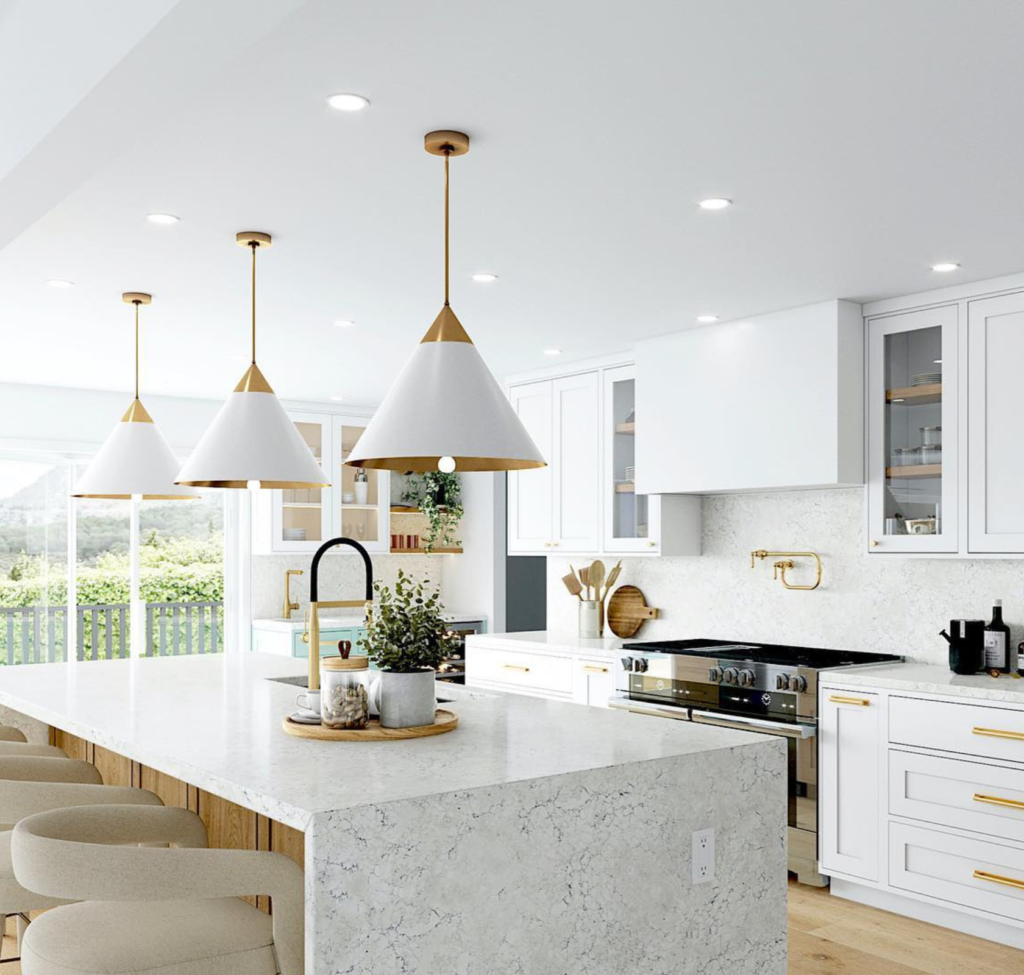
Image Source: blog.1800lighting.com
Planning Your Kitchen’s Illumination Scheme
A successful recessed lighting design for a kitchen creates a layered lighting experience. This means combining different types of light to meet various needs. Think of it as painting with light – you need broad strokes for general brightness, focused beams for specific tasks, and perhaps even subtle touches to highlight features. This approach ensures your kitchen is not only well-lit but also inviting and functional.
The Importance of a Cohesive Kitchen Lighting Layout
A thoughtful kitchen lighting layout is the foundation of good kitchen design. It impacts how you prepare food, how the space feels, and even how your kitchen appliances and cabinets look. Too few lights can leave dark corners and make tasks difficult. Too many can create a glare and feel overwhelming. Finding the sweet spot is key. This involves a strategic placement of lights to avoid shadows and provide even illumination.
Beyond Ambient: Task and Accent Lighting
While ambient lighting provides general illumination for the entire kitchen, task lighting is essential for work areas. This includes countertops, the stovetop, and the sink. Recessed lights are excellent for task lighting when placed directly over these zones. Accent lighting can highlight architectural features, artwork, or decorative elements, adding depth and personality to your kitchen.
Calculating Recessed Lighting Needs: A Step-by-Step Approach
To figure out how many lights for kitchen tasks, we need to get a bit more technical. It’s not just about the size of your kitchen, but also the height of your ceiling and the type of light fixture you choose. This is where ceiling light spacing and recessed fixture spacing come into play.
Step 1: Measure Your Kitchen
Start by accurately measuring the length and width of your kitchen. This will give you the total square footage.
- Length: ____ feet
- Width: ____ feet
- Total Square Footage: Length × Width = ____ sq ft
Step 2: Determine Ceiling Height
Ceiling height significantly influences the spacing of recessed lights. Higher ceilings generally require lights to be spaced closer together or use fixtures with a wider beam spread to adequately illuminate the space.
- Ceiling Height: ____ feet
Step 3: Consider the Purpose of Each Light
Not all lights serve the same purpose. Think about where you’ll need the most light.
- Work Areas (Countertops, Sink, Stove): These require brighter, more focused light.
- Walkways and General Areas: These need adequate, even illumination.
- Highlighting Features: If you have a backsplash or artwork, you might want accent lights.
Step 4: Understand Beam Spread and Fixture Type
The best recessed lighting for kitchens will offer versatility. Recessed lights come with different beam spreads (narrow, medium, wide) and light intensities (lumens).
- Narrow Beam: Good for accent lighting, highlighting specific objects.
- Medium Beam: Suitable for task lighting over countertops or general illumination in smaller areas.
- Wide Beam: Excellent for general ambient lighting in larger spaces or over expansive work surfaces.
A common recommendation for kitchen ceiling light calculation is to use a combination of fixture types for optimal results.
Step 5: The Spacing Rule of Thumb
A widely used rule of thumb for recessed lighting quantity is to divide the ceiling height by two to determine the approximate spacing between lights.
- Spacing Formula: Ceiling Height / 2 = ____ feet
For example, if you have an 8-foot ceiling, you’d place lights roughly every 4 feet. If you have a 10-foot ceiling, you’d space them about every 5 feet.
Step 6: Mapping Out Your Layout
Using your kitchen measurements and the calculated spacing, start mapping out where each light will go.
- Along Walls: Place lights about 2-3 feet away from walls to avoid creating dark perimeters.
- Over Work Surfaces: Position lights directly above the edge of countertops to cast light onto your workspace without shadows.
- In the Center: For general illumination, a grid pattern in the center of the room often works well.
Example Calculation: An 8-foot Ceiling Kitchen
Let’s say your kitchen is 10 feet by 12 feet with 8-foot ceilings.
- Ceiling Height: 8 feet
- Spacing: 8 feet / 2 = 4 feet
- Along the 10-foot walls: You might place lights at approximately 2.5 feet, 6.5 feet, and 10 feet from one corner. This gives you three lights along each 10-foot wall, spaced roughly 4 feet apart, with the outer ones 2.5 feet from the ends.
- Along the 12-foot walls: You could place lights at approximately 2 feet, 6 feet, 10 feet, and 12 feet from one corner. This gives you four lights along each 12-foot wall, spaced roughly 4 feet apart, with the outer ones 2 feet from the ends.
This preliminary calculation suggests around 10-12 lights for a kitchen of this size. However, this is just a starting point.
Step 7: Adjusting for Light Output (Lumens)
The number of lumens your chosen recessed lights produce is also critical. Higher lumen lights can cover a larger area, potentially reducing the total number of fixtures needed.
- Low Ceilings (7-8 feet): Typically require 600-800 lumens per fixture for general lighting.
- Medium Ceilings (9-10 feet): Typically require 800-1000 lumens per fixture.
- High Ceilings (10+ feet): May require 1000-1500 lumens or more per fixture, or a wider beam spread.
Lumens vs. Watts: A Quick Guide
| Light Type | Typical Lumens | Equivalent Watts (Incandescent) |
|---|---|---|
| LED (Warm White) | 800 | 60-75 |
| LED (Cool White) | 800 | 60-75 |
By selecting fixtures with higher lumen output, you might be able to achieve adequate kitchen light placement with fewer units.
Step 8: Layering Lights for Functionality
Remember, the goal is not just to fill the ceiling but to create zones of light.
- Task Lighting: Place dedicated recessed lights directly over work areas like countertops and the island. These should be spaced closely enough to eliminate shadows. A common approach is to place them 12-18 inches from the cabinet edge.
- Ambient Lighting: Use wider beam fixtures spaced according to the ceiling height rule of thumb for general illumination across the kitchen.
- Accent Lighting: Use adjustable or directional recessed lights to highlight specific features, such as art or textured walls.
This layered approach ensures that how many recessed lights in kitchen areas is determined by need, not just by a uniform pattern.
Common Pitfalls to Avoid in Recessed Lighting Design
Even with careful planning, designers and homeowners can fall into common traps when implementing recessed lighting design.
Pitfall 1: Too Much Glare
This often happens when lights are placed too close together or when the wrong type of fixture is used, especially over work surfaces.
- Solution: Use recessed lights with diffused lenses or frosted glass. Ensure task lights are positioned correctly to avoid direct glare on surfaces. Consider using smart dimmers for adjustable brightness.
Pitfall 2: Dark Corners and Shadows
This is the result of insufficient lighting or poor kitchen light placement.
- Solution: Review your layout. Are lights spaced too far apart? Are there areas not covered by any fixtures? Consider adding more lights or using fixtures with a wider beam spread in less critical areas. Ensure lights are placed within 2-3 feet of walls.
Pitfall 3: Over-Reliance on a Single Light Type
Using only one type of recessed fixture for the entire kitchen can lead to an unbalanced lighting scheme.
- Solution: Mix and match. Use narrower beams for task lighting, wider beams for general illumination, and adjustable ones for accents. This variety creates a more dynamic and functional kitchen lighting layout.
Pitfall 4: Ignoring the Scale of the Room
A small kitchen might feel overwhelmed by too many large fixtures, while a large kitchen can feel dim with too few.
- Solution: Choose fixture sizes appropriate for your ceiling height and room dimensions. Generally, 4-inch or 6-inch recessed housings are common for kitchens, with 4-inch often being preferred for smaller or lower-ceilinged kitchens to avoid an overbearing look.
Pitfall 5: Incorrect Spacing for Task Lighting
Simply applying the general spacing rule to task areas won’t provide optimal task illumination.
- Solution: For countertops, place lights approximately 12-18 inches in from the edge of the cabinets above them. This ensures the light falls directly onto the workspace, minimizing shadows from your body.
Choosing the Best Recessed Lighting for Kitchens
The selection of fixtures is as important as their placement. When looking for the best recessed lighting for kitchens, consider these factors:
Beam Spread and Angle
- Wide Flood (WFL): Typically a 90-100 degree beam spread, ideal for general ambient lighting over larger areas.
- Flood (FL): Around a 50-60 degree beam spread, good for task lighting and illuminating medium-sized areas.
- Spot (SP): A narrower beam spread (10-25 degrees), best for accent lighting and highlighting specific points.
- Narrow Spot (NSP): An even tighter beam (under 10 degrees), for very focused accent lighting.
For most kitchens, a mix of WFL or FL for ambient and task lighting, and SP for accents, is ideal.
Color Temperature (Kelvin)
Color temperature affects the mood and functionality of your kitchen.
- Warm White (2700K-3000K): Creates a cozy, inviting atmosphere, similar to incandescent bulbs. Good for general ambiance.
- Neutral White (3500K-4000K): A good balance of warm and cool, often considered ideal for kitchens as it provides good visibility for tasks without being too harsh.
- Cool White/Daylight (4500K-6500K): Can feel stark and sterile in a kitchen, though some prefer it for very bright, task-oriented environments.
Most professionals recommend 3000K or 3500K for kitchen recessed lighting.
Dimmability
Dimmable fixtures allow you to adjust the light level to suit different activities and times of day. This is a must-have for creating a versatile kitchen lighting layout. Ensure your dimmer switch is compatible with your chosen LED lights.
Trim Style
The trim is the visible part of the fixture that sits against the ceiling.
- Baffle Trim: Has concentric rings that help reduce glare. Often preferred for kitchens.
- Reflector Trim: Has a mirrored surface to reflect light. Can be bright.
- Gimbal/Adjustable Trim: Allows you to angle the light beam, useful for accent lighting.
- Pinhole Trim: Creates a small, focused beam of light.
IC-Rated vs. Non-IC Rated Housings
- IC-Rated (Insulation Contact): Can be installed directly against building insulation, preventing heat buildup and fire hazards. Essential for most residential applications.
- Non-IC Rated: Requires clearance from insulation, often used in remodel projects or where insulation is not a factor. Always check local building codes.
Frequently Asked Questions About Kitchen Recessed Lighting
Q1: How far apart should recessed lights be in a kitchen?
Generally, for ambient lighting, space them about every 4 to 6 feet, or use the rule of thumb: divide your ceiling height by two. For task lighting over countertops, place them 12-18 inches from the cabinet edge.
Q2: What size recessed lights are best for a kitchen?
4-inch or 6-inch recessed housings are most common. 4-inch lights can be less obtrusive in smaller kitchens or those with lower ceilings, while 6-inch lights offer broader light distribution and may be suitable for larger spaces.
Q3: Do I need more recessed lights in my kitchen than in a living room?
Yes, typically kitchens require more focused and brighter lighting due to the task-oriented nature of the space. Task areas like countertops, sinks, and stoves need ample light to prevent shadows.
Q4: Can I use recessed lights as the only light source in my kitchen?
While recessed lights can provide excellent ambient and task lighting, a well-designed kitchen often benefits from additional lighting layers, such as under-cabinet lights, pendant lights over an island, or wall sconces, to enhance functionality and aesthetics.
Q5: How many lumens do I need per recessed light in a kitchen?
For general kitchen lighting, aim for 800-1000 lumens per fixture, especially with 9-10 foot ceilings. Adjust based on ceiling height, room size, and the desired brightness.
Q6: What is the best color temperature for kitchen recessed lighting?
A neutral white (3500K) is often recommended as it provides excellent visibility for tasks while still feeling inviting. Warm white (2700K-3000K) is also a good option for a cozier feel.
By following these guidelines for recessed lighting quantity, ceiling light spacing, and kitchen light placement, you can create a beautifully lit and highly functional kitchen space. Remember, a good kitchen lighting layout is a blend of art and science, ensuring both illumination and atmosphere.