
The ideal number of pot lights in a kitchen is typically one light for every 8 to 10 square feet, but this can vary based on ceiling height, fixture brightness, and desired lighting effects. To achieve perfect illumination, a thoughtful kitchen lighting layout is essential, considering the number of recessed lights for the kitchen, optimal pot light spacing in the kitchen, and how kitchen ceiling light spacing contributes to the overall ambiance. This guide will help you determine the right quantity of recessed lighting for your kitchen size and understand the factors that influence your kitchen lighting design.
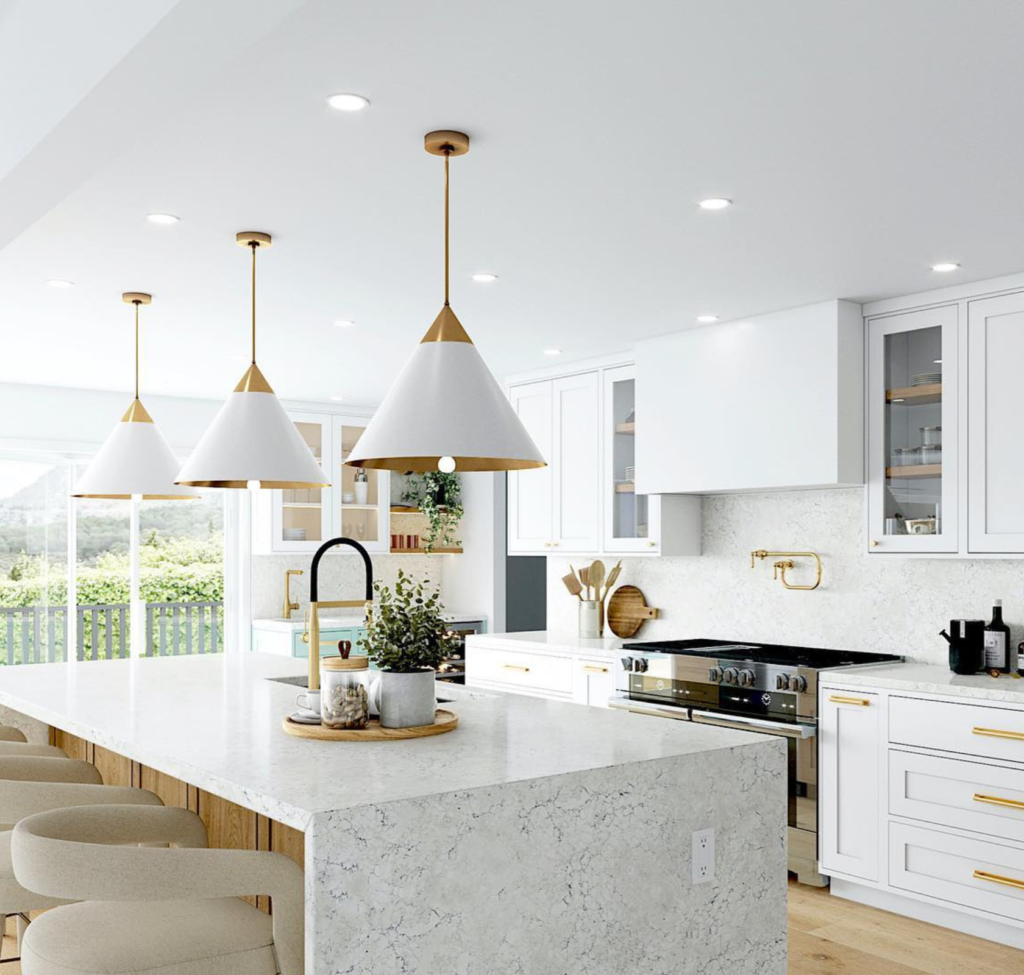
Image Source: blog.1800lighting.com
Planning Your Kitchen Lighting Layout
Creating a well-lit kitchen goes beyond simply scattering a few lights across the ceiling. A strategic kitchen lighting layout ensures that every corner of your workspace is adequately illuminated, tasks can be performed safely and efficiently, and the overall atmosphere is inviting. This involves layering different types of lighting, with recessed lighting often forming the foundational ambient layer.
Deciphering the Number of Recessed Lights for Your Kitchen
Determining pot light quantity for your kitchen isn’t an exact science, but a well-established formula can serve as an excellent starting point. The general rule of thumb for number of recessed lights for kitchen areas is to aim for one fixture every 8 to 10 square feet. This is a guideline, and factors like ceiling height, the beam angle of your chosen pot lights, and the wattage or lumen output will significantly influence the final count.
Calculating Kitchen Pot Lights: The Basic Formula
To start calculating, you’ll need the dimensions of your kitchen. Let’s say your kitchen is 10 feet wide by 12 feet long.
- Calculate the area: 10 feet * 12 feet = 120 square feet.
- Apply the rule of thumb:
- Using 8 sq ft per light: 120 sq ft / 8 sq ft/light = 15 pot lights.
- Using 10 sq ft per light: 120 sq ft / 10 sq ft/light = 12 pot lights.
This initial calculation provides a range. Now, we need to refine this by considering other crucial factors.
Optimizing Pot Light Spacing in the Kitchen
Proper optimal pot light spacing kitchen is key to avoiding dark spots and overly bright areas. The spacing between fixtures is as important as the total number.
Factors Influencing Pot Light Spacing
- Ceiling Height: Higher ceilings require lights to be spaced further apart. A common guideline is to space pot lights at a distance equal to half their ceiling height. For example, on an 8-foot ceiling, you might space lights 4 feet apart. On a 10-foot ceiling, you might space them 5 feet apart.
- Beam Angle: Pot lights come with different beam angles. Wider beam angles (e.g., 90-120 degrees) spread light over a larger area, allowing for wider spacing. Narrower beam angles (e.g., 30-60 degrees) concentrate light, requiring closer spacing for even coverage.
- Lumens per Pot Light: The brightness of each pot light, measured in lumens, plays a significant role. Brighter lights can cover larger areas, meaning you might need fewer fixtures if you opt for higher lumen output.
Spacing Guidelines for Common Ceiling Heights
Here’s a general guide for kitchen ceiling light spacing:
| Ceiling Height | Optimal Pot Light Spacing (Center to Center) |
|---|---|
| 8 feet | 4-5 feet |
| 9 feet | 4.5-5.5 feet |
| 10 feet | 5-6 feet |
| 12 feet | 6-7 feet |
Important Note: These are starting points. Always consider the fixture’s specific beam spread and lumen output.
Illuminating Key Kitchen Zones
Beyond general ambient lighting, specific areas within your kitchen require focused attention.
Kitchen Island Lighting
A kitchen island lighting plan is a critical component of your overall kitchen lighting design. Pot lights can be used over an island, but they are often supplemented by pendant lights or chandeliers to provide task lighting and create a visual focal point.
- Task Lighting for Islands: If using pot lights, ensure they are positioned directly over the working surface of the island. Spacing should be closer here to prevent shadows when chopping or preparing food. A good rule is to place them no more than 2-3 feet from the edge of the island.
- Aesthetic Considerations: The number and placement of lights over an island should also consider the aesthetic. Too many lights can feel overwhelming; too few can leave the island feeling dim.
Workspace Illumination
- Countertops: Ensure there are no dark spots along your countertops. Pot lights should be placed no more than 2-3 feet from the walls to illuminate the backsplash and countertop areas effectively. Consider placing them along the center of your work zones.
- Sink Area: The sink is a crucial task area. Position pot lights to ensure ample light for washing dishes and food preparation without creating shadows.
How Many Lumens Per Pot Light Kitchen?
The brightness of your pot lights, measured in lumens, is a vital factor in determining pot light quantity. Higher lumen output means each light can cover a larger area or provide more intense light where needed.
General Lumens Recommendations for Kitchens
For general ambient lighting in a kitchen, a common recommendation is:
- 10-15 lumens per square foot: This provides a comfortable, general level of light.
- 20-50 lumens per square foot: For task lighting areas like countertops and the kitchen island.
Calculating Required Lumens:
Let’s revisit our 120 sq ft kitchen.
- For ambient lighting: 120 sq ft * 10 lumens/sq ft = 1200 lumens.
- For ambient lighting: 120 sq ft * 15 lumens/sq ft = 1800 lumens.
So, your entire kitchen needs between 1200 and 1800 lumens for general illumination. If you have 10 pot lights, each would need to output an average of 120-180 lumens.
However, this is for the total output. We need to consider how to distribute this.
How many lumens per pot light kitchen should you aim for?
For most recessed downlights used for general kitchen illumination, a lumen output of 600-800 lumens per fixture is a good starting point.
- If you aim for 800 lumens per light and need a total of 1500 lumens for ambient light: 1500 lumens / 800 lumens/light = 1.87 lights. This simplified calculation clearly shows why the “1 light per 8-10 sq ft” rule is more practical.
Let’s re-evaluate using the “1 light per 8-10 sq ft” rule with lumen output in mind.
- 120 sq ft kitchen: Using the 1 light per 8 sq ft rule, we get 15 lights. If each light is 600 lumens: 15 lights * 600 lumens/light = 9000 total lumens. This is a much brighter scenario, allowing for dimmer controls to adjust the mood.
- 120 sq ft kitchen: Using the 1 light per 10 sq ft rule, we get 12 lights. If each light is 800 lumens: 12 lights * 800 lumens/light = 9600 total lumens.
This demonstrates that a higher lumen output per fixture allows for potentially fewer fixtures while still achieving ample brightness. However, spreading the light from multiple sources generally creates more even illumination.
Refined Pot Light Placement Based on Room Dimensions
The basic 8-10 sq ft rule is a starting point. Let’s refine it for different kitchen ceiling light spacing scenarios.
Layout Example: A 10ft x 12ft Kitchen
- Area: 120 sq ft.
- Using 1 light per 8 sq ft: 15 lights.
- Using 1 light per 10 sq ft: 12 lights.
For a 10ft x 12ft kitchen with an 8ft ceiling:
- Spacing: 4-5 feet apart.
If we place them on a grid:
- Along the 12ft wall: Divide 12ft by 4ft spacing = 3 sections. You’d likely need 4 lights along this wall.
- Along the 10ft wall: Divide 10ft by 4ft spacing = 2.5 sections. You’d likely need 3 lights along this wall.
This gives us 4 lights * 3 lights = 12 lights. This aligns with the 10 sq ft per light rule.
Placement Strategy for a 10ft x 12ft Kitchen (12 Lights):
- Two rows of lights along the 12ft length: Place lights 5ft from each 10ft wall and 5ft from each 12ft wall. This would mean lights are 5ft apart along the 12ft dimension.
- Three rows of lights along the 10ft width: Place lights 2.5ft from each 12ft wall and then divide the remaining 7ft by 3.5ft spacing, resulting in lights approximately 2.5ft, 6ft, and 9.5ft from one wall. This creates 3 lights along the 10ft dimension.
Grid Example:
12′ +—–+—–+—–+ | | | | 2.5′ | | | | +—–+—–+—–+ | | | | 4′ | | | | +—–+—–+—–+ | | | | 2.5′ | | | | +—–+—–+—–+ 3.5′ 3.5′ 3.5′ (approx.)
This grid would use 12 lights, spaced roughly 4 feet apart in one direction and 3.5 feet apart in the other.
Considerations for Different Kitchen Sizes
The recessed lighting kitchen size will dictate the overall number of fixtures.
Small Kitchens (e.g., 8ft x 10ft)
- Area: 80 sq ft.
- Rule of Thumb (8 sq ft/light): 10 lights.
- Rule of Thumb (10 sq ft/light): 8 lights.
- Ceiling Height: For an 8ft ceiling, spacing around 4 feet.
- Layout: Likely 2 rows of 4 lights each, spaced 4 feet apart along the 10ft length and 4 feet apart along the 8ft width. This would be 8 lights. You could add 2 more lights to the center of each long wall for improved coverage.
Medium Kitchens (e.g., 10ft x 15ft)
- Area: 150 sq ft.
- Rule of Thumb (8 sq ft/light): ~19 lights.
- Rule of Thumb (10 sq ft/light): 15 lights.
- Ceiling Height: For an 8ft ceiling, spacing around 4 feet.
- Layout: Consider 3 rows of 5 lights each, or 4 rows of 4 lights each. For 15 lights on a 10×15 ft room with 8ft ceilings:
- Along 15ft wall: 15ft / 5ft spacing = 3 sections, requiring 4 lights.
- Along 10ft wall: 10ft / 4ft spacing = 2.5 sections, requiring 3 lights.
- 4 lights * 3 lights = 12 lights. This is a good baseline. You might add 2-3 more lights in critical task areas or to break up larger spaces.
Large Kitchens (e.g., 15ft x 20ft and larger)
- Area: 300 sq ft.
- Rule of Thumb (8 sq ft/light): ~38 lights.
- Rule of Thumb (10 sq ft/light): 30 lights.
- Ceiling Height: For 9-10ft ceilings, spacing around 5 feet.
- Layout: You’ll be looking at grids of 5×6 or 6×5 lights. It’s crucial to break down large kitchens into zones.
- Consider 5 lights along the 20ft dimension (spaced 5ft apart) and 6 lights along the 15ft dimension (spaced 3ft apart). This gives 30 lights.
- Alternatively, 6 lights along the 20ft dimension (spaced ~4ft apart) and 5 lights along the 15ft dimension (spaced 3ft apart). This gives 30 lights.
Incorporating Other Lighting Layers
Pot lights are excellent for ambient and general task lighting, but a complete kitchen lighting design requires more.
Task Lighting
- Under-Cabinet Lighting: This is crucial for illuminating countertops. LED strips or puck lights provide bright, shadow-free light exactly where you need it for food prep.
- Pendant Lights: Often used over kitchen islands or peninsulas, pendants provide focused task lighting and serve as decorative elements.
- Sconce Lighting: Wall sconces can add accent lighting and help reduce shadows in darker corners.
Accent Lighting
- In-Cabinet Lighting: Illuminating glassware or decorative items inside glass-front cabinets adds depth and visual interest.
- Uplighting: Lights placed on top of cabinets can cast light upwards, highlighting architectural features or creating a softer glow.
Advanced Considerations for Your Kitchen Lighting Design
- Dimmers: Installing dimmers on all pot lights is highly recommended. This allows you to adjust the brightness for different activities and moods, from bright task lighting to a soft, ambient glow.
- Color Temperature (Kelvin): The color of light affects the feel of the kitchen.
- Warm White (2700K-3000K): Creates a cozy, inviting atmosphere.
- Cool White (3500K-4000K): Better for task lighting and a more energetic feel.
- Daylight (5000K+): Mimics natural daylight but can feel harsh if overused.
For kitchens, a mix is often best, with slightly cooler tones for task areas and warmer tones for ambient lighting.
- Beam Angle: As mentioned earlier, the beam angle of your pot lights is critical. Wider beams are good for general coverage, while narrower beams are better for task lighting or highlighting specific features.
- Color Rendering Index (CRI): A higher CRI (90+) ensures colors appear natural under the light, which is important for food preparation and general aesthetics.
- Smart Lighting: Consider smart bulbs or systems that allow for color changing, scheduling, and remote control, adding convenience and flexibility to your kitchen lighting.
Frequently Asked Questions (FAQ)
Q: How many pot lights should I put on a 10-foot ceiling?
A: For a 10-foot ceiling, you can generally space pot lights about 5-6 feet apart. The formula of 1 light per 8-10 square feet still applies, but you’ll need more lumens or a wider beam angle to cover the same area compared to an 8-foot ceiling.
Q: Can I use dimmer switches with all my pot lights?
A: Yes, using dimmer switches is highly recommended. Ensure the pot lights and the dimmer switch are compatible. Dimmers provide flexibility to adjust the light intensity for different times of day and activities.
Q: What’s the difference between ambient, task, and accent lighting in a kitchen?
A: Ambient lighting provides general illumination for the entire room (often from pot lights). Task lighting is focused light for specific activities like cooking or reading (e.g., under-cabinet lights, pendant lights over an island). Accent lighting highlights specific features, such as artwork or architectural details.
Q: How do I avoid shadows when placing pot lights?
A: To avoid shadows, ensure lights are placed strategically over work areas like countertops and the sink. Avoid placing lights too close to walls or in a way that your body will block the light when you’re performing a task. Overlapping the light beams from adjacent fixtures helps create even illumination.
Q: Should pot lights be centered in the ceiling?
A: Not necessarily. While centering can work in very simple layouts, effective kitchen lighting design often involves placing pot lights in relation to the room’s layout, including cabinets, islands, and walkways, to maximize functionality and aesthetics.
By carefully considering the kitchen size, ceiling height, desired lumens per pot light, and the principles of kitchen lighting layout, you can achieve perfect illumination in your kitchen, making it a more functional and enjoyable space. Remember that a layered lighting approach, combining pot lights with other fixtures, will yield the best results.